
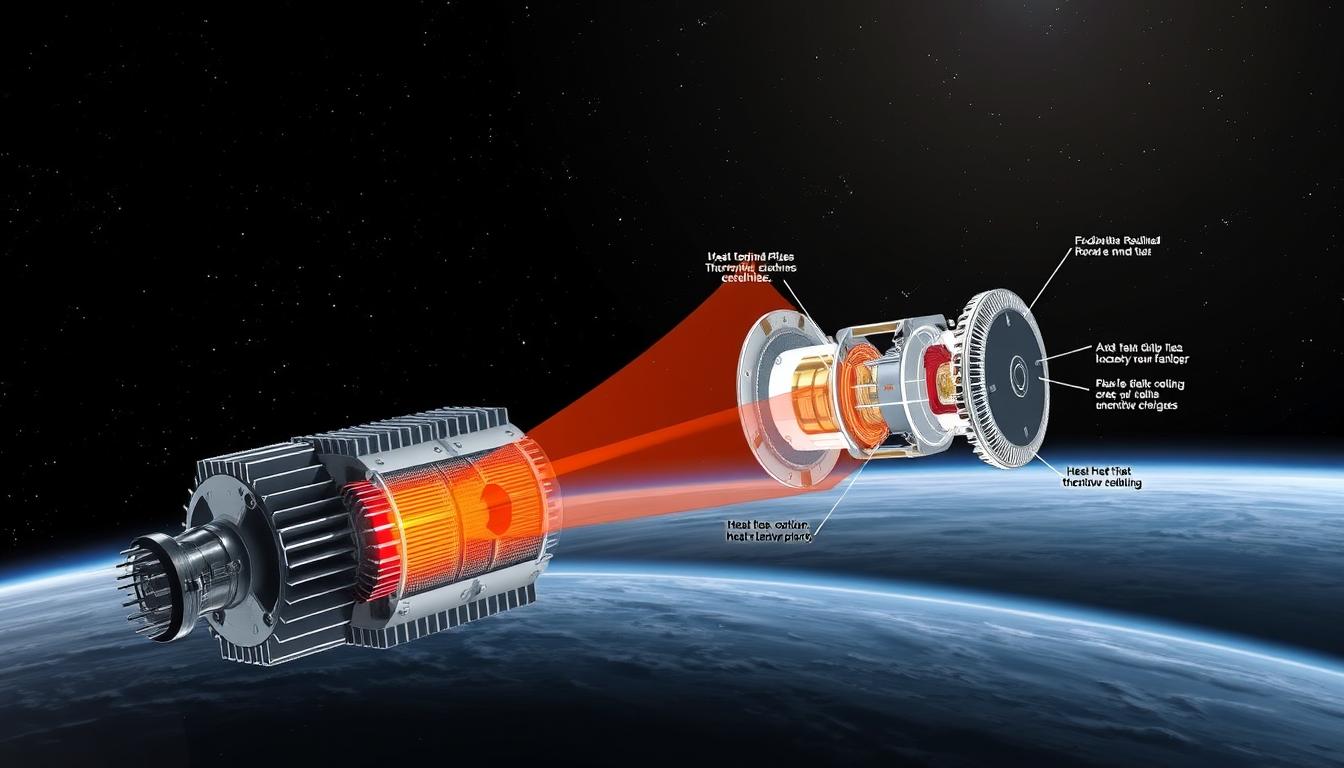
Understanding how heat sinks work in space is key. They keep electronic devices cool, which is critical in space. Their ability to work in a vacuum is essential for space missions.
Thermal management in space is a big challenge. Heat sinks help cool devices, but they don’t work the same in space as they do on Earth. We need to understand how vacuum environments affect their performance. This article explores whether heat sinks work in a vacuum, how heat transfer differs in space, and the best solutions for spacecraft and satellites.
Understanding Heat Sinks and Their Basic Function
Heat sinks are devices that absorb and release heat. They keep systems at the right temperature. Heat transfer is key to their work, happening through conduction, convection, and radiation.
Heat sinks have a base plate, fins, and a thermal interface material. These parts help in transferring heat. On Earth, air movement helps in cooling systems, making them work well.
- Conduction: the transfer of heat through direct contact between particles or objects
- Convection: the transfer of heat through the movement of fluids
- Radiation: the transfer of heat through electromagnetic waves
The Physics of Heat Transfer in Different Environments
Heat transfer is a key concept in physics. It happens through conduction, convection, and thermal radiation. In vacuum environments, convection is almost non-existent. Heat mainly moves through thermal radiation and conduction.
Understanding how heat moves in different places is vital. This is true, more so in space where there’s no air. In vacuum environments, thermal radiation is a big player in heat transfer. Thermal radiation is how heat moves through electromagnetic waves. It’s the main way heat moves in space. The amount of radiation an object sends out depends on its temperature and how it looks on the surface.
Several things can change how heat moves in space:
- How hot or cold objects are
- The surface of objects, like how well they reflect or absorb heat
- How far apart objects are
Studies on heat transfer in space have led to better ways to manage heat in space. These systems help keep spacecraft and satellites working well. By knowing how heat moves in space, engineers can make better systems. This lets us explore and study space more easily.
Do Heat Sinks Work in a Vacuum: The Scientific Answer
Heat sinks help cool electronic devices, but how well do they work in space? In space, there’s no air to carry heat away. So, heat sinks use conduction and radiation to cool down.
Conduction in Vacuum Conditions
In space, heat mainly moves through touching. Heat sinks need to be made of materials that conduct heat well. This helps them cool down faster.
Radiation Heat Transfer
Radiation is also key in space. Heat sinks must release heat through radiation. This is done by using surfaces that send out heat well. It’s vital for keeping things cool in space.
Space Applications and Thermal Management
Thermal management is key in space, where temperatures can be extreme. Cooling systems are vital for keeping spacecraft and satellites at the right temperature. Radiative cooling is a top method because it doesn’t need a medium to transfer heat.
Space technology has grown a lot, making efficient cooling systems possible. These systems work in vacuum environments, where old cooling methods fail. Heat pipes, radiators, and insulation materials are some of the main technologies used.
Satellite Cooling Systems
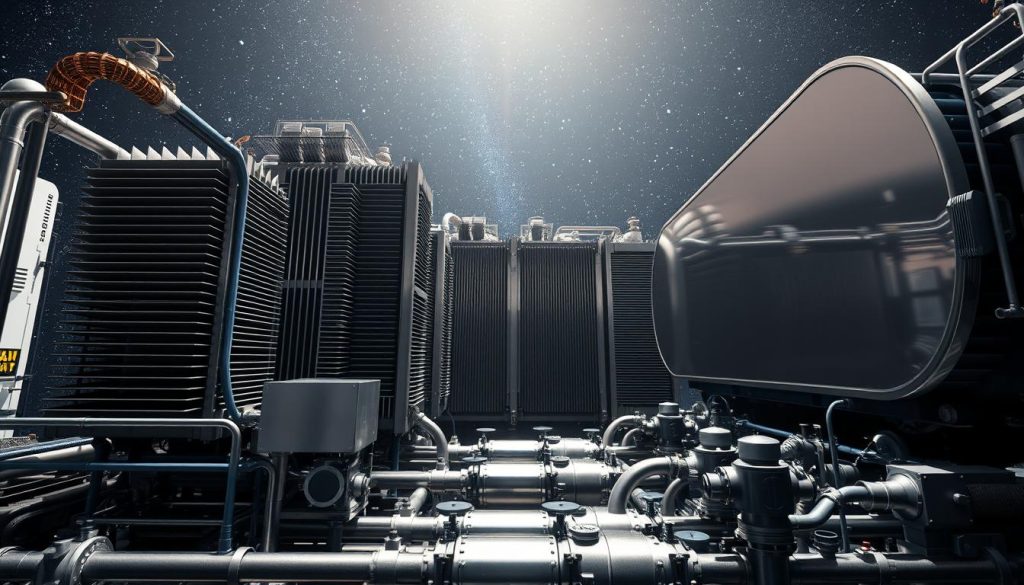
Satellite cooling systems keep satellites at a stable temperature. This ensures they work well and last longer. They use radiative cooling and heat pipes to move heat away from the electronics.
Future Space Technology Developments
Future space tech will improve cooling systems and thermal management. New materials and technologies, like advanced radiators and heat exchangers, will be created. These will make space missions more efficient and reliable, opening up new possibilities for exploration.
Design Modifications for Vacuum Operation
Heat sinks need special design changes to work well in vacuum spaces. These changes include better fin shapes, improved thermal connections, and special materials. The aim is to boost heat transfer through conduction and radiation. This makes the heat sink work better in vacuum settings.
Choosing materials with high thermal conductivity is key. This helps in transferring heat through conduction, which is vital without air to help. The fin structure’s design is also important. It must be optimized to increase the surface area for radiative heat transfer.
Some design changes for vacuum heat sinks include:
- Using materials with high thermal conductivity, such as copper or aluminum
- Optimizing the fin structure to maximize surface area for radiative heat transfer
- Enhancing thermal interfaces to reduce thermal resistance
- Using specialized coatings or surfaces to enhance radiative heat transfer
Improving heat sink design for vacuum environments is a focus of ongoing research. New materials and technologies are being explored to enhance heat sink performance. As the need for dependable electronic systems in space grows, so does the need for effective heat sink design.
Conclusion: The Future of Thermal Management in Vacuum Environments
The future of thermal management in vacuum environments looks bright. New materials, designs, and technologies are leading to big breakthroughs. As we explore space more, we’ll need better thermal management systems to keep new tech working in the vacuum’s harsh conditions.
As we venture further into space, keeping things cool will become even more important. Thanks to ongoing research, we’ll soon have better cooling systems. These will help new space technologies succeed, leading to amazing discoveries and a deeper understanding of our universe.
FAQ
What is a heat sink?
A heat sink is a device that absorbs and spreads out heat. It uses conduction, convection, and radiation to do this.
How does heat transfer occur in a vacuum environment?
In a vacuum, heat mainly spreads through radiation and conduction. Convection is almost non-existent because of no air.
What are the limitations and challenges of using heat sinks in vacuum environments?
The big issues are lower heat transfer rates and higher temperatures. These problems make cooling in space hard.
What are the future developments in thermal management for vacuum environments?
The future for cooling in space looks bright. New materials, designs, and technologies will help. This will open up new possibilities for space exploration and technology.


